Quality Practice Series #18 (October 2026) |
Message from the Voluntary Assisted Dying Board Chair |
Following the retirement of Dr Scott Blackwell, we welcomed new Board member, Dr Simon Towler to the Board, appointed from 27 July 2026. Dr Towler will be known to many of you as the Department of Health's former Chief Medical Officer. He also brings experience as a member of the Ministerial Expert Panel on Voluntary Assisted Dying, the Chair of the Voluntary Assisted Dying Review Panel and as a VAD practitioner. The Board recently presented the 2025-2026 Annual Report to the Minister for Health, reflecting on the increase in activity in the Financial Year and making further recommendations for improvements to the operations of voluntary assisted dying. We have distributed copies of the report following its tabling in Parliament. The Board also congratulates Amanda Silla, Manager, End of Life Care Program, Department of Health, on the publication of her Churchill Fellowship Report examining international approaches to decision-making on assisted dying methods and practitioner guidance for the day of administration. Amanda's report can be downloaded here. |
|
|
|
|
|
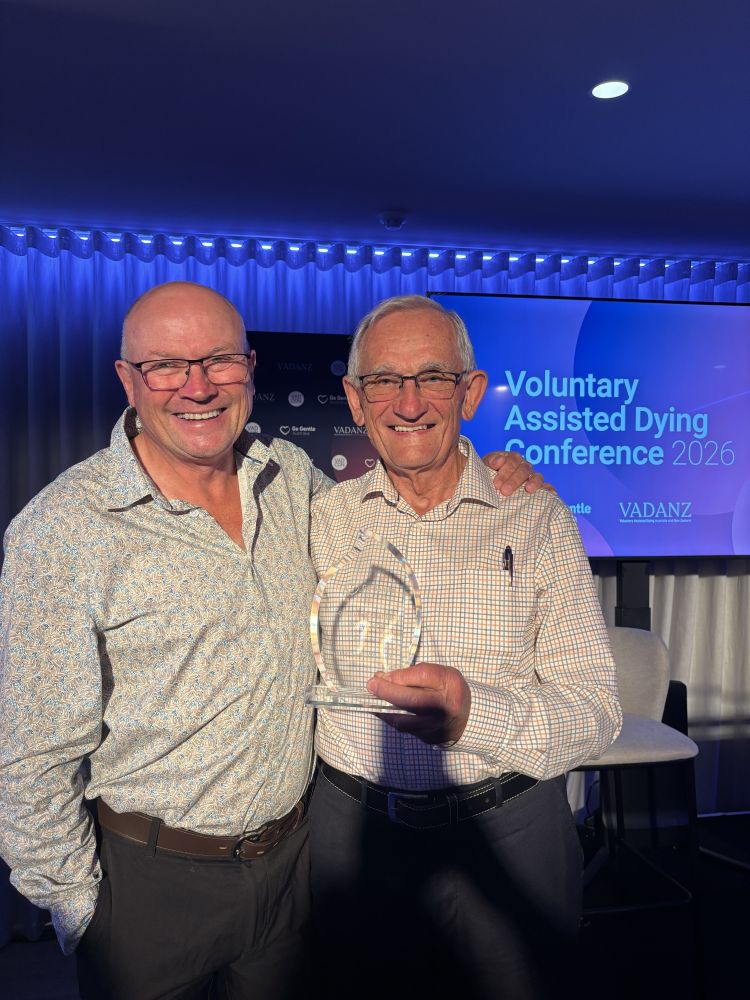
Board and Secretariat Unit members recently attended VADCON26 in Melbourne along with practitioners, pharmacists, care navigators and VAD coordinators from around Australia and New Zealand. We were delighted to see Dr Scott Blackwell recognised as the Go Gentle Individual Community Champion at the Awards Dinner. We also congratulate Dr Clare Fellingham for her election as President of VADANZ, the peak body for VAD health professionals. Hon Colin Holt
Chair - Voluntary Assisted Dying Board |
| |
|
|
|
Enhancements to VAD-IMS were rolled out to users in early September. These enhancements include updates to the practitioner registration process, an updated Administering Practitioner Disposal Form, and a new process for transferring multiple episode roles. Further details on the enhancements and full instructions can be downloaded from the VAD-IMS Resource Hub. |
Community Awareness Campaign |
The Department of Health has scheduled an integrated End-of-Life Care community awareness campaign to run from December 2026 to May 2027. The campaign will promote awareness of Advance Care Planning, Palliative Care, and Voluntary Assisted Dying (VAD) as part of a broader end-of-life care information initiative. The campaign's primary audience is Western Australians aged over 60 years, with secondary messaging directed towards family members, carers, and loved ones aged 40 to 59 years. Campaign activities will include: |
- Distribution of Advance Care Planning, Palliative Care, and VAD brochures to
approximately 270 GP practices across Western Australia. - Display of end-of-life care promotional materials and video content within
participating GP waiting rooms. - Targeted social media advertising and sponsored media content to support community awareness and engagement.
|
For VAD practitioners, the campaign may result in increased public awareness of VAD and greater understanding of available end-of-life care options. This could lead to more enquiries about VAD and encourage earlier engagement by patients who may be considering the pathway. Earlier awareness and discussion of VAD may assist patients, families, and practitioners by allowing more time to navigate eligibility assessments, care planning, and decision-making processes, potentially reducing some of the challenges associated with urgent or late-stage requests. Monitoring of website and social media engagement will provide insights into audience interaction with the campaign and help inform future communication activities. |
Final Requests made in the Designated Period |
The Board recently conducted a consultation during the Statewide Care Navigator Service VAD Practitioner Forum to better understand the factors contributing to the
increasing number and proportion of patients making their Final Request for
voluntary assisted dying within the designated nine-day period between First
Request and Final Request and involved voluntary assisted dying practitioners, Statewide service providers, pharmacists, care navigators and Health Service Provider VAD Coordinators. Participants identified a range of interrelated factors influencing expedited pathway access, including awareness and knowledge gaps, delayed engagement with the VAD process, rapid clinical deterioration, practitioner knowledge and confidence, workforce and access challenges in regional areas, barriers to referral and care coordination processes, and legislative, regulatory and governance factors. The report on the consultation is attached to this email. The Board will use the findings to inform its statutory functions of monitoring the operation of the Act and identifying opportunities for quality improvement within the voluntary assisted dying system. |
Archives of previous editions |
Previous editions of the Quality Practice Series can be downloaded from the Resource Hub in VAD-IMS. |
|
|
|
|
This document can be made available in alternative formats on request for a person with disability.
© Department of Health 2026
Copyright to this material is vested in the State of Western Australia unless otherwise indicated. Apart from any fair dealing for the purposes of private study, research, criticism or review, as permitted under the provisions of the Copyright Act 1968, no part may be reproduced or re-used for any purposes whatsoever without written permission of the State of Western Australia |
|
|
|
|
|
|